Category: Jewelry Buying Tips

Practical guidance for choosing and buying jewelry.

  • CVD vs. HPHT Lab-Grown Diamonds: What the Method Tells You

    CVD vs. HPHT Lab-Grown Diamonds: What the Method Tells You

    You have two lab-grown diamonds open in separate browser tabs. One listing says CVD; the other says HPHT. The prices and photos look close, and now you are wondering whether one method automatically makes a better diamond.

    The short answer: the letters describe how the crystal was grown. They are useful information, but they are not a quality grade. To compare the finished stones, look at the individual diamond, its grading information, any disclosed treatment, and the seller’s written description.

    What CVD and HPHT mean

    HPHT stands for high pressure, high temperature. In this method, equipment applies intense pressure and heat to carbon around a tiny diamond seed. CVD means chemical vapor deposition: carbon-containing gas in a chamber deposits carbon onto a diamond seed as the crystal grows. The Gemological Institute of America (GIA) explains both processes in its overview of HPHT and CVD diamond growth.

    Both methods produce laboratory-grown diamonds. GIA explains that these are diamonds, not look-alike simulants such as cubic zirconia or moissanite. The growth environment can leave characteristics that trained gemologists use for identification, but a shopper should not expect to identify the method by eye from a listing photo.

    A growth method is not a quality score

    CVD and HPHT do not rank diamonds from best to worst. The method alone does not tell you whether the finished stone has the cut appearance you prefer, the color and clarity you want, or a better price for your budget. Compare the specific stones and their documentation rather than choosing only by the letters CVD or HPHT.

    Some CVD-grown diamonds may receive post-growth treatment, including HPHT treatment, to improve or change color. That does not mean every CVD stone has been treated. It does mean treatment disclosure is a sensible question for any candidate, especially when comparing two stones that otherwise seem similar.

    What to check in the listing and report

    Start with the product description, then compare it with the grading document. GIA says three of its four Laboratory-Grown Diamond Report types include a comment naming CVD or HPHT; this is specific to those GIA report types, so do not assume every laboratory uses the same report format. See GIA’s explanation of which reports show the growth method.

    • Identity: Does the report describe a laboratory-grown diamond, and can you verify its report number with the issuing laboratory?
    • Growth method: Is CVD or HPHT stated in the report or seller paperwork? If it is missing, ask the seller to clarify rather than guessing from appearance.
    • Treatment: Ask whether the stone received any post-growth treatment and where that information appears in the report or sales paperwork.
    • Finished stone: Compare cut, color, clarity, measurements, and carat weight for the exact stones. Review actual photos or video when available.
    • Written terms: Make sure the invoice or order description identifies the stone as laboratory-grown and records any origin or treatment details the seller has stated.

    The Federal Trade Commission’s jewelry buying advice recommends getting important details—such as origin, weight or size, and treatments—in the sales paperwork. It also advises checking a seller’s return policy in writing. A product page may be useful, but save the specific listing and ask for the key details on the order itself.

    A simple side-by-side comparison

    Make a small table for your two candidates. Put the report number, growth method, disclosed treatments, cut, color, clarity, measurements, price, and return terms in matching rows. If one stone has incomplete information, ask the seller the same questions about both before deciding. This keeps the comparison focused on the diamonds you might actually buy.

    Then ask yourself what you notice in the finished stones: which one looks better to your eye in the photos or viewing appointment, and does the documentation match the listing? If a seller cannot clearly explain whether a stone is lab-grown or what its paperwork says, take your time and compare another listing.

    CVD and HPHT are helpful clues about a diamond’s path from seed crystal to finished gem. Use them to ask informed questions, then choose from the documented qualities and appearance of the individual stone.

    Further reading

  • How to Compare Karat Gold, Gold-Filled, and Gold-Plated Jewelry

    How to Compare Karat Gold, Gold-Filled, and Gold-Plated Jewelry

    You find two gold-colored chains that look almost identical in the product photos. One is listed as 14K gold; the other says “14K gold plated.” The small difference in wording matters: one describes the gold alloy throughout the piece, while the other describes a gold surface layer over another metal. Before comparing prices, make sure you know which construction you are looking at.

    Here is a simple way to read the language, ask better questions, and compare like with like. The FTC’s consumer guidance and Jewelry Guides are useful U.S. references; terminology and marking rules can vary by country.

    First, separate karat from the kind of construction

    Karat (usually written K) measures the proportion of gold in a gold alloy. Twenty-four karat is pure gold; 18K means 18 parts gold out of 24, and 14K means 14 parts gold out of 24. The balance is other metals. The FTC explains this ratio in its guide to buying gold, platinum, and silver jewelry, and GIA describes the same fineness system in its gold jewelry buying guide.

    “Gold plated,” by contrast, describes a surface treatment. A plated item has a layer of gold over a base metal. Gold-filled, gold overlay, and rolled gold plate are also surface-layer descriptions, but they refer to mechanically applied gold and have specific usage in U.S. guidance. Vermeil describes gold over a sterling-silver base. These terms do not mean the same thing as a piece made throughout from a gold alloy.

    One more wording trap: the FTC uses “solid gold” to mean that an item is not hollow. It does not by itself tell you the karat. Check the karat mark and the rest of the description as well.

    Read the product listing as a specification

    Before checkout, look for the full description, not only a short title or a tiny stamp in a photo. Record these details for each piece you are comparing:

    • Gold content: Is a karat given, such as 14K or 18K? Is it the alloy of the whole item or only the gold layer?
    • Construction: Does the seller say karat gold, gold-filled, gold overlay, rolled gold plate, gold electroplate, gold plated, gold flashed, or vermeil?
    • Base metal: If there is a surface layer, what material is underneath? For vermeil, the base should be identified as sterling silver.
    • Coverage and components: Does the description apply to the chain, clasp, pendant, posts, backs, and any other visibly separate parts?
    • Mark and responsible business: For U.S. purchases, the FTC recommends looking near a gold karat mark for the name or registered trademark of the business standing behind it.

    The FTC notes that plating can wear over time, depending on how the piece is worn and on the layer’s thickness. It also distinguishes terms such as gold-filled and gold electroplate by how the layer is applied and described. If the listing uses a vague phrase like “gold tone,” “gold finish,” or “gold flashed,” ask the seller to state plainly whether the item is gold alloy throughout or a base metal with a gold surface.

    Ask these questions before you pay

    • “Is the entire piece made of 14K/18K gold alloy, or is only the surface gold?”
    • “What is the base metal, and does the stated metal description cover the clasp and all components?”
    • “If it is plated, filled, overlay, or vermeil, what exact term and karat of the layer do you use?”
    • “Can you send a close-up of the quality mark and identify the business name or trademark associated with it?”
    • “What written product description and return terms will appear on my order?”

    A reputable seller should be able to answer clearly and in writing. If the listing, stamp, and answer do not agree—or the seller avoids saying what the base metal is—pause and compare another item. A close-up photo can help you read a mark, but appearance alone cannot establish metal content.

    Compare pieces on the same basis

    For a fair comparison, place items in separate columns: alloy and karat; surface-layer type; base metal; which parts are covered; weight or dimensions if provided; care instructions; and return terms. Do not compare a 14K alloy piece with a plated piece as if “14K” described the whole item in both cases. Do not assume that a higher karat automatically makes a better choice for every design; decide first what construction you want, then compare pieces within that category.

    A little careful reading turns a confusing listing into a clear choice. The goal is not to memorize every marking. It is to know exactly what the seller means by “gold” before you decide whether the piece fits your budget, use, and expectations.

    Further reading

  • How to Read a Diamond Grading Report Before You Buy

    How to Read a Diamond Grading Report Before You Buy

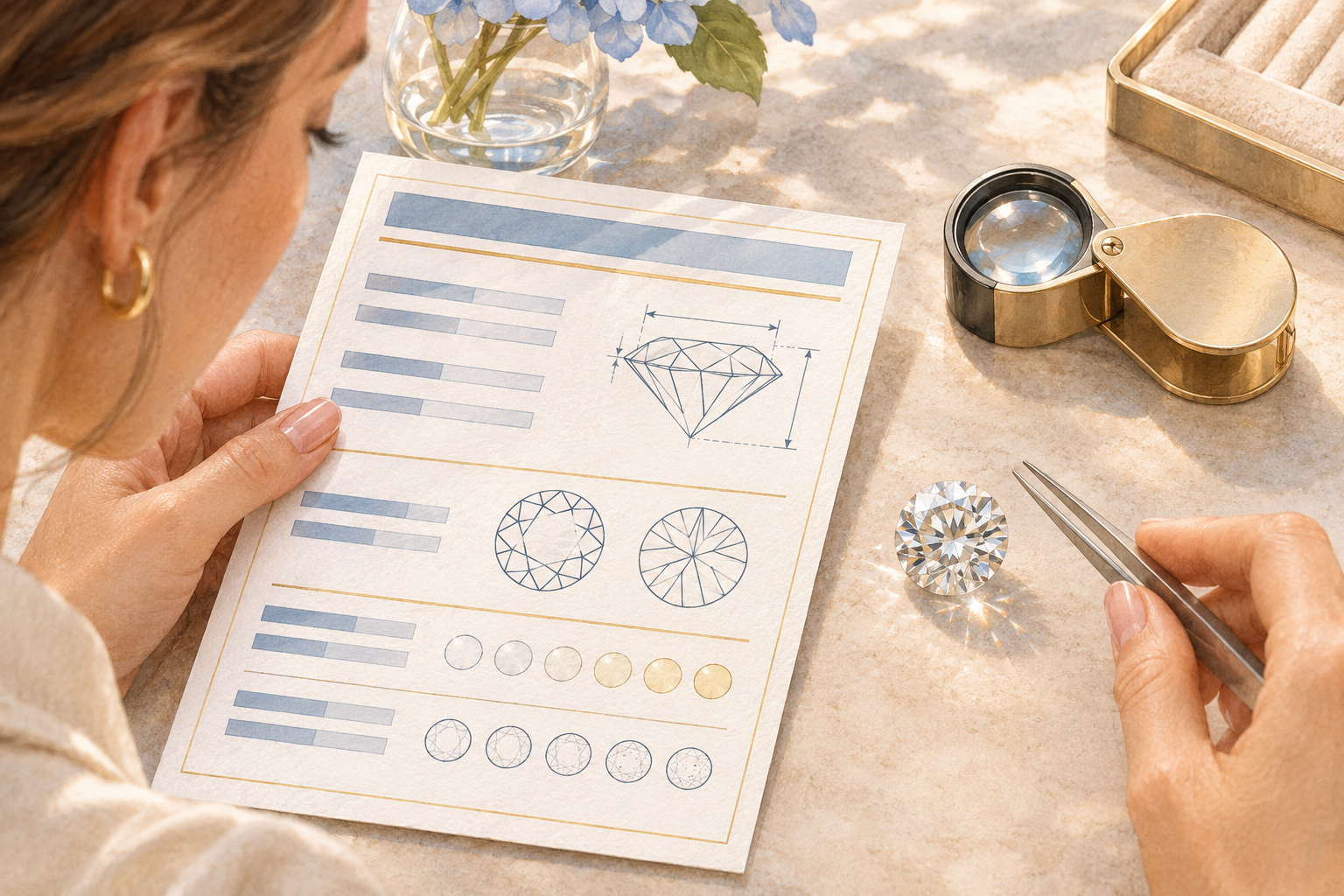
    You have two diamonds open on your screen. One is described as “excellent, eye-clean, and beautiful”; the other comes with a grading report full of abbreviations, measurements, and tiny diagrams. Before comparing the price, pause and ask a more useful question: does this report describe the exact diamond being offered, and what can it actually tell me?

    A grading report gives you structured information about a stone. It is not a price tag, a guarantee of future value, or a substitute for seeing the diamond. GIA explains that a Diamond Grading Report records the 4Cs and identifying details, while an appraisal is a separate estimate of monetary worth. GIA’s explanation of reports and appraisals lays out that difference.

    First confirm what kind of report you have

    Read the report heading and the description of the item. A GIA Diamond Grading Report applies to a loose natural diamond in the D-to-Z color range, while GIA offers different report formats for other types of diamonds and services. A report may be digital or printed, and the details included can vary by report type and date.

    The report itself is not a universal “certificate” that tells you what the finished ring is worth. GIA describes its grading report as an assessment of a diamond’s qualities, and says it does not provide an appraisal value. Treat the document as one part of your comparison rather than as a promise about market price.

    Read the main fields in a useful order

    Start with the report number, shape and cutting style, measurements, and carat weight. These help you orient yourself to the stone being described. Then review color, clarity, and cut information. GIA’s guide to reading a Diamond Grading Report explains the fields, including the proportion diagram, clarity plot, polish, symmetry, and comments.

    Look at the cut grade with its limits in mind. GIA’s cut grade applies to standard round brilliant diamonds in the D-to-Z color range; other shapes do not receive that same overall cut grade. A missing cut grade on a fancy shape does not mean the report is incomplete. For those stones, compare the actual face-up appearance, proportions, and finish with the seller’s details.

    The clarity plot is a map of characteristics, not a promise that you will see every mark unaided. Ask to view the diamond under consistent lighting and magnification, and compare the report’s description with what you can see. If eye visibility matters to you, make that a direct question rather than assuming the clarity letter answers it.

    Check that the report and diamond belong together

    Enter the report number in GIA Report Check or follow the report’s QR code when available. GIA says Report Check lets users compare report information with its archived database. This confirms a database match for the number; it does not by itself establish that the physical stone in a seller’s display is the stone represented by the report.

    Ask the seller to show how the loose stone is matched to the document. If the report lists a laser inscription on the girdle, ask to see it through a loupe and compare the number. Not every report or diamond includes an inscription, so use the report’s own details. If there is no inscription or you still have doubts, ask whether an independent gemologist can compare the stone with the report before the return period ends.

    For a mounted diamond, some details may be harder to inspect, and a grading report can have a different scope from an appraisal of the complete ring. Ask what exactly the document covers: the center stone, the setting, or both. GIA notes that it issues Diamond Grading Reports for loose stones, so a report associated with a mounted ring may have been created before setting.

    Compare two reports without getting lost in the letters

    Make a short side-by-side table for the diamonds you are considering. Put the report type and number first, then measurements and shape, followed by the 4Cs and any comments or treatments. Add what the seller’s price includes: the setting, taxes, return terms, warranty, and any service. This keeps you from comparing one loose stone with one finished ring as if they were identical purchases.

    Use the measurements and your eyes together. Carat weight measures weight, not how large a diamond looks from above. Two stones with similar weight can have different face-up dimensions or proportions. You already have a separate guide to comparing round diamond measurements; here, use the report measurements as an identity and comparison aid, not as a substitute for seeing the cut.

    Avoid treating one grade as an automatic winner. A higher grade in one category may not matter as much to you as a look you prefer or a setting you like. Compare the stones in person or through clear, consistent images, and ask the seller to explain any difference you do not understand.

    Questions to ask before paying

    • Which report type is this, and what exact stone does it describe?
    • Can I look up this report number in the issuing laboratory’s database?
    • Does the report list a girdle inscription, and can you show it to me?
    • Is the diamond loose or mounted, and which parts of the jewelry are covered by the document?
    • What information does the report leave out, including price, appraisal value, or the setting?
    • Can I have the stone independently checked during the return period?
    • What is the written return policy if the stone does not match its report or description?

    A report should make the comparison clearer

    A good buying process is simple: verify the report number, match the report to the actual stone, compare the fields that matter to your priorities, and evaluate the finished diamond under the conditions in which you expect to wear it. If the seller welcomes those questions and gives you time to review the terms, you can make the decision with a clearer picture of what you are buying.

    Further reading

  • How to Choose a Gemstone for an Everyday Ring

    How to Choose a Gemstone for an Everyday Ring

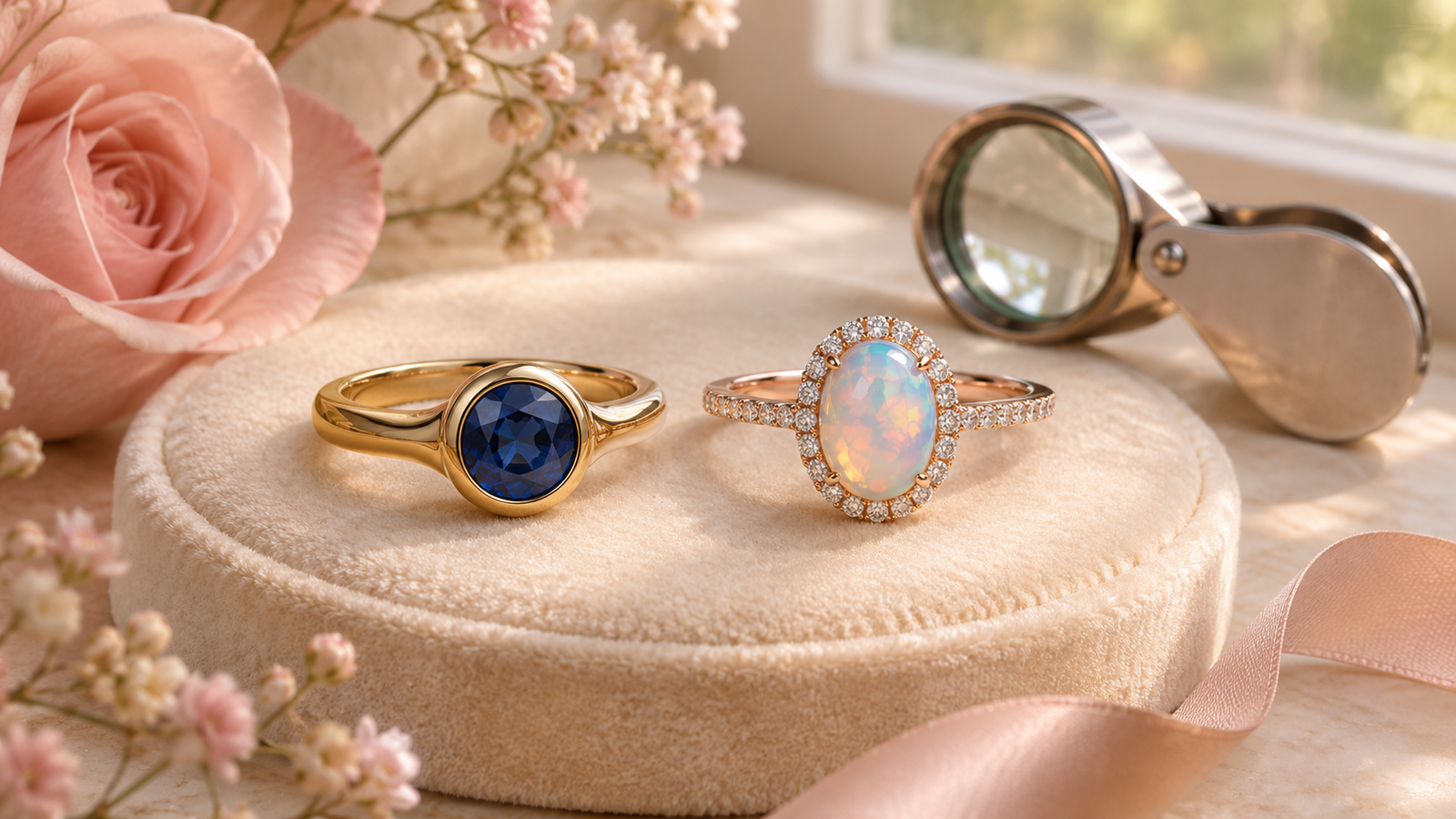
    You find a vivid sapphire and a glowing opal in the same jewelry case. Both look beautiful, but you plan to wear the ring most days—at work, while running errands, and around the house. The useful question is not simply, “Which stone is harder?” It is, “How will this gem handle the way I actually wear a ring?”

    Gem durability has three parts: hardness (resistance to scratches), toughness (resistance to chips and breaks), and stability (resistance to heat, light, and chemicals). The Gemological Institute of America (GIA) explains that these are separate properties, so a high hardness number alone cannot tell you whether a ring is carefree. GIA’s overview of gemstone durability is a useful starting point.

    Start with how your hands spend the day

    Think through an ordinary week. Do you remove rings for exercise, gardening, cleaning, or hands-on work? Do you often knock your hands against counters or equipment? Does the ring need to stay on through frequent handwashing? These habits matter because a ring stone sits exposed on a moving hand, where it may meet hard surfaces, grit, lotions, and household products.

    There is no single gemstone that is right for everyone. A stone that suits someone who removes jewelry before chores may be a poor fit for someone who wants to wear the same ring continuously. Be honest about your routine before you compare color or price.

    Use the three-part durability check

    1. Hardness: how easily can the surface scratch?

    Hardness describes resistance to scratching and abrasion. The familiar Mohs scale is comparative, and its numbers are not evenly spaced: the difference between two neighboring numbers is not a fixed amount. GIA notes that sapphire and ruby, both corundum, rank 9 on the Mohs scale and are relatively hard. That makes hardness one useful part of the comparison, but it is not the whole answer.

    2. Toughness: how vulnerable is it to a knock?

    Toughness describes resistance to breaking, chipping, or splitting. Ask where the stone has exposed corners, points, or edges, and whether the design shields them. A protective bezel or a setting with a raised rim can reduce how much of the gem is exposed to a direct bump. No setting makes a gemstone indestructible, but shape and protection can change the risks of everyday contact.

    3. Stability: what can heat, light, or chemicals do?

    Stability concerns how the gem responds to its environment. Treatments can change the care a stone needs. For example, GIA says untreated and heat-treated sapphires are durable, while some fracture-filled or dyed sapphires need gentler cleaning and protection from certain chemicals. Ask about the specific stone and its treatments before assuming that general advice for a gem variety applies to the ring in front of you.

    Compare two very different ring choices

    Sapphire: A sapphire can be a strong candidate for a frequently worn ring. GIA describes corundum as relatively hard, with excellent toughness and no cleavage, and says it is well suited to rings subject to daily wear. Still, the treatment matters. Ask whether the sapphire has been fracture-filled, cavity-filled, dyed, or treated in another way that changes cleaning or care.

    Opal: Opal can be a lovely choice when its color play is what you love most, but it calls for more thoughtful wear. GIA notes that opal is less hard than many gems and is vulnerable to scratches and chips; for someone tough on jewelry, it recommends a protective setting or treating an opal ring as a piece that needs extra care. That does not make opal a bad choice. It means your habits and the setting should be part of the decision.

    If you like a softer or more care-sensitive stone, consider whether you would enjoy wearing it on days when you can be mindful of it—or whether the same gem might suit a pendant better. The right answer is the one that fits both your taste and your routine.

    Inspect the setting as carefully as the gemstone

    Ask to see the ring from the side as well as from above. Notice whether the stone sits high, whether its corners or edges are exposed, and whether the band feels substantial enough for your use. Look for prongs that appear even and secure. A beautiful center stone still depends on a well-made setting to stay in place and avoid unnecessary knocks.

    For an online purchase, request clear side-view photographs and a written description of the setting. Ask whether the seller recommends removing the ring for chores, sports, or cleaning, and what inspection or maintenance is included after purchase.

    Questions to ask before you pay

    • What is the gem variety, and is it natural, laboratory-grown, or an imitation?
    • Has the stone been treated? If so, what treatment, and how does it affect care?
    • How would you describe its hardness, toughness, and stability for my routine?
    • Does this setting protect the gem’s corners, edges, or exposed surface?
    • Which cleaning methods and products should I avoid?
    • What should I do if a prong loosens or the stone appears chipped?
    • Can I have the care instructions, treatment disclosure, warranty, and return terms in writing?

    A practical choice, not a hardness contest

    Before choosing, score each ring against your real life: scratch resistance, resistance to impact, sensitivity to environmental conditions, protection from the setting, and the care you are willing to give it. Then compare stones only after the seller has clearly explained treatment and maintenance. GIA’s sapphire care guide and opal ring durability FAQ show why two attractive gems can call for different habits and settings.

    Further reading

  • How to Choose Storage That Slows Sterling Silver Tarnish

    How to Choose Storage That Slows Sterling Silver Tarnish

    You open a drawer to pull out a silver necklace for dinner and find that the chain has darkened since you last wore it. Later, you’re looking at two storage options online. One is a velvet jewelry box with plenty of room. The other is a small pouch marked anti-tarnish. Before buying either one, picture how your necklace will sit inside it and ask what material will actually surround the silver.

    Those are two separate questions. A compartment gives a chain its own place so it doesn’t rub against your rings or tangle with another necklace. A tarnish-inhibiting wrap or pouch addresses what reaches the surface while the piece is stored. A plain lined box can be useful for organizing, and you can put a separate anti-tarnish pouch inside it.

    Ask what makes the pouch anti-tarnish

    The Gemological Institute of America’s jewelry care guide recommends an anti-tarnish bag or cloth for sterling silver. For a product labeled anti-tarnish, ask the seller whether the pouch fabric itself is formulated for silver or whether it comes with a separate insert. If it uses an insert, check whether the maker gives directions for when to replace it. Look for a description of the material and how the pouch closes.

    The Canadian Conservation Institute’s silver care guide explains that sulfur-containing gases can cause silver to tarnish. Its storage examples include protecting individual silver objects in sealed polyethylene bags, with a suitable wrap such as unbuffered, sulfur-free archival tissue or a tarnish-inhibiting cloth. If you already have a jewelry box you enjoy, a separate pouch for the silver pieces you wear least often may be all the extra storage you need.

    Do a fit test with the piece you wear

    For a necklace, loop the chain loosely as you’d want it to sit and measure the space it takes up. If it has a pendant, include that in the measurement. Compare those dimensions with the pouch’s usable interior, especially if a drawstring or flap takes up part of the opening. You want to lift the necklace out without catching the clasp in the lining.

    For a pair of earrings, check that the posts have room and that the pieces can sit separately. A ring with a raised setting may be easier to put away in its own padded compartment than in a flat pouch. If you’re deciding between two sizes online, draw the advertised interior dimensions on a piece of paper and set the jewelry on it. It’s a quick way to see whether a pouch that sounds roomy gives you enough room in practice.

    Check what else is on the jewelry

    For a silver piece set with pearls or opals, follow the storage guidance for the whole piece. GIA notes that some gems, including pearls and opals, can suffer in very dry storage. Ask the jeweler what they recommend for your particular piece before adding a drying packet. For antique or deliberately darkened silver, ask about the intended finish before polishing. The Canadian Conservation Institute notes that polish can remove some surface metal, so it’s worth knowing which areas were meant to stay dark.

    Three questions to ask before you buy

    • Which part of the pouch or box is designed to slow tarnish, and does it have care or replacement instructions?
    • What are the usable inside dimensions, and can my piece sit comfortably on its own?
    • What does the jeweler recommend if the piece also has pearls, opals, or a deliberately dark finish?

    Start with one piece you tend to leave in the drawer. Put its pouch where you already take the jewelry off, or set it inside the box you use every day. The best fit is one you’ll actually reach for when you come home.

    Further reading

    • Gemological Institute of America — Tips on Caring for Jewelry. Find jewelry-specific storage advice for sterling silver and tips for protecting pieces that contain gemstones.
    • Canadian Conservation Institute — Silver Care and Tarnish Removal. Learn what causes silver to tarnish and see examples of protective storage materials.
  • How to Compare Pearl Strands for Luster and Matching

    How to Compare Pearl Strands for Luster and Matching

    You’re choosing between two pearl necklaces. In one listing, each pearl is so bright it looks as though a window is reflected in it. In the other, the pearls have a soft glow. The photos were taken on different backgrounds, and one is zoomed in so far that you can’t see the clasp. Before deciding which strand you like better, ask to see both under the same light.

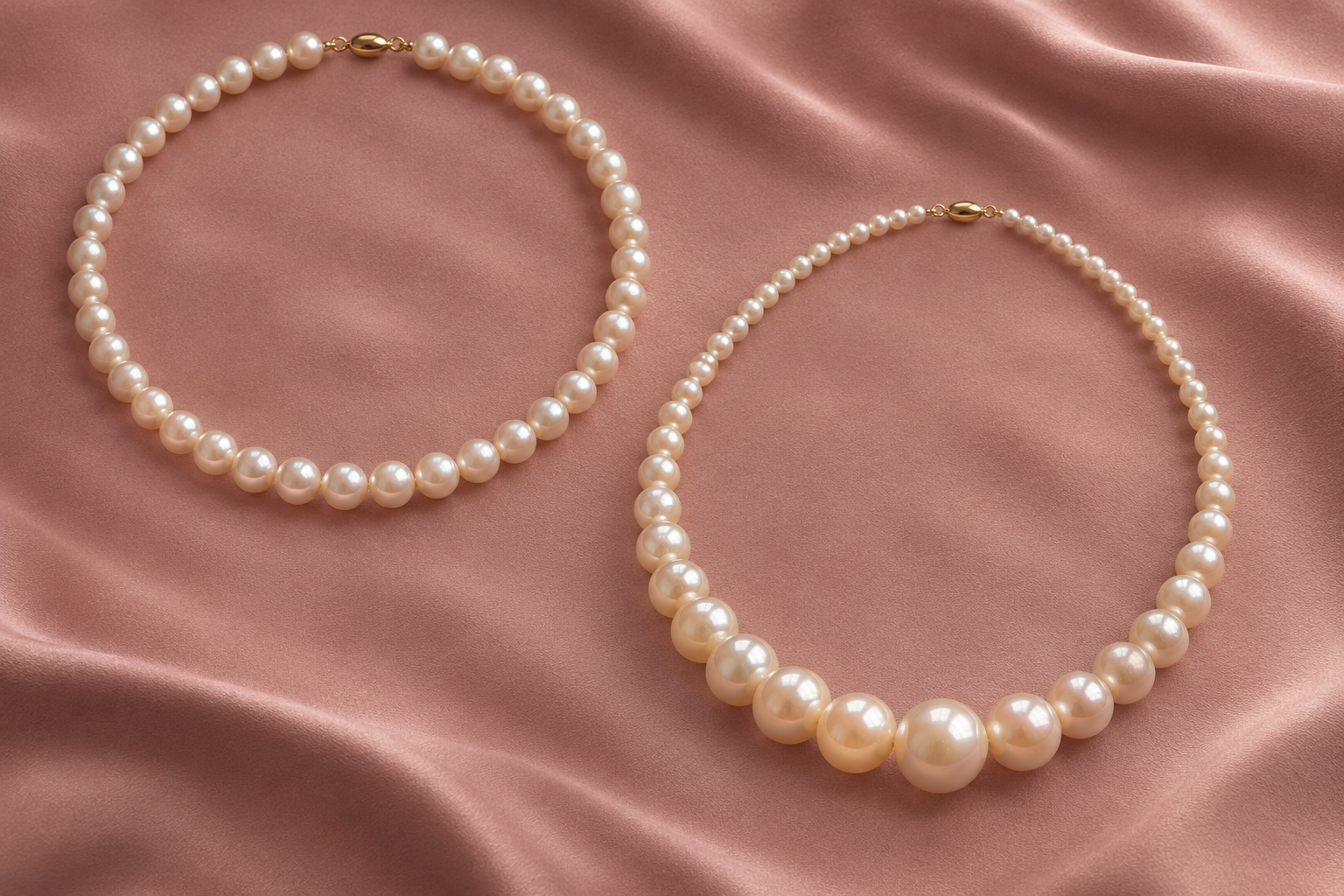
    That comparison gives you a way to judge two different things. Look at the reflections on individual pearls for luster. Then look at how the pearls work together along the necklace for matching. A single close-up can tell you a little about the first. You’ll want to see the whole piece for the second.

    Compare reflections under the same light

    The Gemological Institute of America’s guide to pearl quality describes stronger luster in terms of brighter, sharper reflections. At a counter, ask to set the two strands on the same plain surface in one spot. Look for the edge of a reflected light or window as you change your viewing angle. Does it look distinct, do the edges soften, or does the bright area spread out into a haze? Compare several pearls on each necklace.

    Online, ask for a short unfiltered video of the exact strands side by side. Give the seller one simple setup to use for both, such as a plain background near a window in indirect daylight. Ask them to tilt the strands slowly and keep the camera distance the same. If you’re comparing listings from different stores, ask each for similar views and treat any comparison as approximate. GIA also notes that luster standards differ by pearl variety, so comparing strands of the same type gives you a more relevant starting point.

    Follow the pattern from the center to the clasp

    If you want an evenly sized strand, follow one side from the center toward the clasp. Look at the size, shape, color, and reflections from one pearl to the next. Do the changes feel subtle, or does one pearl jump out when you look at the whole necklace? The GIA pearl buyer’s guide lists matching among the factors used to evaluate jewelry containing multiple pearls.

    If you like a graduated strand, where the pearls step down in size toward the ends, compare the left and right sides at roughly the same distance from the center. Ask for the smallest and largest pearl measurements and look at how the change reads when the necklace is curved as it would be when worn. For a multicolored or irregularly shaped strand, look for a mix you actually enjoy. GIA points out that designers sometimes choose differences on purpose. You can still ask whether an abrupt change you see is part of that design.

    Separate marks on the surface from the overall reflections. Take a closer look if one pearl has a spot that catches your eye, then step back to the distance at which you’d usually see the necklace. For an online purchase, ask for photos of the section you’d like to inspect more closely, including the pearls near the clasp if the full-strand shot leaves them in shadow.

    Ask for details about the exact necklace

    • Can you show me the whole strand and close-ups of the center and both ends under the same light?
    • What pearl type is this, what is the size range in millimeters, and is the variation in size or color intentional?
    • If there’s a lab report, can I see the full report and confirm that it covers this strand?

    Read what the report actually covers. GIA’s pearl report comparison shows that its identification report records details such as size and detectable treatments, while its identification and classification report also addresses luster, surface, and matching where applicable. A good photo helps you compare the look of two necklaces. A report answers different questions about the pearls that were examined.

    Before you pay, describe the strand you prefer in one sentence. You might like the way the bright reflections carry through the whole piece, or the way the pearls taper gently away from the center. That’s a better basis for choosing than trying to remember which listing looked brightest on your phone.

    Further reading

    • Gemological Institute of America — Pearl Quality Factors. See illustrated examples of luster grades, surface characteristics, and matching.
    • Gemological Institute of America — Pearl Buyer’s Guide. Browse examples of the size, shape, color, and other details you can compare before buying.
    • Gemological Institute of America — Pearl Reports & Services. Compare report types and see which ones cover luster and matching.
  • Before You Customize a Ring Online, Check What You Can Return

    Before You Customize a Ring Online, Check What You Can Return

    You’ve found a band you love. The listing says “30-day returns,” and right below the size menu is a little box for engraving. Type in a date, choose a size, and the ring feels like yours already. Before you click Buy, take a minute to find out whether the return policy covers the ring exactly as it appears in your cart.

    The easiest way to compare sellers is to run the same test on each one. Ask what would happen if the ring arrived as described, you tried it on indoors, and you decided it wasn’t right. Then ask again with your chosen size change or engraving included.

    Compare the stock ring with the ring in your cart

    Open the item listing and the full return policy side by side. Look for terms such as personalized, made to order, resized, and final sale. A size selected from a menu could be an item the seller already stocks or a piece they’ll alter for you. Ask which applies to your ring and how the seller treats that order for returns.

    Try sending one message that gives the seller something concrete to answer. “I’m considering this exact ring in size 7. Is that a stock size or will you resize this piece? If I order it plain and it doesn’t suit me, can I return it for a refund? Does the answer change if you engrave the inside?” Include the listing link or item number and save the written reply with your order details.

    Turn the return window into a calendar date

    Ask what starts the clock and what finishes it. Does day one begin when the ring ships or when it’s delivered? Do you have to ask for a return authorization, hand the package to the carrier, or have the seller receive it by the deadline? If the ring is a gift, compare that date with when the recipient will actually try it on.

    Check the rules for trying it on, too. Ask whether tags must stay attached and which items must go back with it, such as the box, grading report, or original paperwork. If you want an independent inspection, ask whether the return terms allow it and make sure there’s time to arrange it. The Gemological Institute of America includes the return policy and shipping arrangements among the questions to ask when buying a diamond online.

    Ask how much money you’d actually get back

    The Federal Trade Commission’s online shopping guide recommends checking return shipping costs, the deadline, and any restocking fee. For a ring, add two questions about the way you’re ordering it. Will the seller refund the sizing or engraving charge? And will the refund go back to your original payment method, or is the offer an exchange or store credit? Ask who supplies the return label and whether the seller requires insurance or a particular carrier.

    If you’re buying through a marketplace, read its buyer protection rules alongside the seller’s policy. The FTC’s marketplace guide recommends checking whether the platform’s protection applies to your item and seller. Ask separately what to do if the seller sends the wrong size or misspells the engraving. Save the spelling you approved and the exact size on the order.

    Make the call before paying

    • Eligibility: Can I return this exact item with the options in my cart?
    • Deadline: When does the window start, and what must happen before it closes?
    • Refund: What goes back to my original payment method after fees and shipping?

    If fit is still uncertain, ask whether you can order a returnable stock size first and add engraving later. Confirm the cost and the effect of that later work on any warranty or remaining return rights. If you’re happy to order a final-sale piece, you’ll know exactly what you’re agreeing to before the ring is made yours.

    Further reading

    • Federal Trade Commission — Online Shopping. Check what to look for in delivery terms, refund policies, and return shipping costs.
    • Gemological Institute of America — 10 Tips for Buying a Diamond Online. See what to ask diamond sellers about grading reports, returns, and insured shipping.
    • Federal Trade Commission — Buying From an Online Marketplace. Learn how to check buyer protection and keep records of what the seller promises.
  • Can a Vintage Ring Be Resized? What to Ask Before You Buy

    Can a Vintage Ring Be Resized? What to Ask Before You Buy

    You find a vintage ring with the kind of engraving you’ve been looking for. The seller lists it as a size 5½. You usually wear a 7. Before you picture it on your hand, ask the seller to turn the ring over. The back of the band can tell a jeweler as much about the work ahead as the lovely part you saw first.

    The question to ask is whether this particular ring can reach your size while keeping the details that made you want it. Get an answer about the work, the cost, and the return terms before you pay.

    Ask to see the underside of the ring

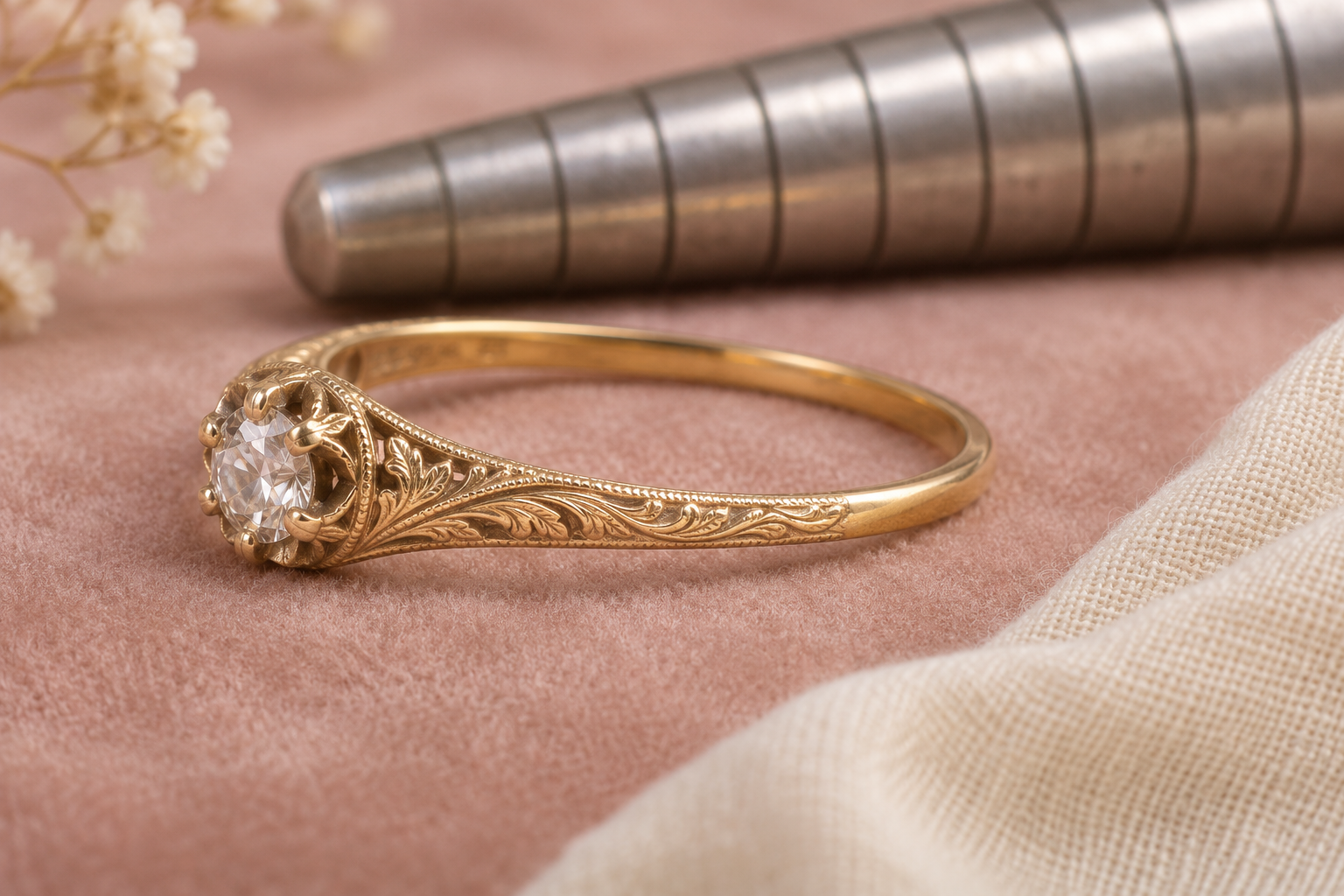
    The band that wraps around the finger is called the shank. For an online listing, ask for a sharp photo of the underside and another of the inside of the band. A photo can show where the pattern ends, whether there’s an inscription, and where the metal looks thin. The Gemological Institute of America’s guide to antique and vintage engagement rings explains that some vintage rings are difficult to resize, especially when the change is substantial, and that a worn shank sometimes needs partial replacement.

    Point out the detail you most want to preserve. If it’s the engraving, ask where the jeweler expects to work and whether a plain section or a break in the pattern could be visible afterward. If it’s an inscription, ask whether the work would affect the letters. Photos help start that conversation. Ask whether the jeweler needs the ring in hand to give you a firm answer.

    Have your size checked for the width you’ll wear

    If you can, visit a jeweler and try on a sizing band similar in width to the vintage ring. Bring along any band you plan to wear with it and explain how you’d like the pair to feel. Tell the seller the size your jeweler measured, along with the sizing system you’re using. For a ring listed abroad, ask the seller to confirm the equivalent measurement.

    Then ask whoever will do the work whether they can reach that size. If they say the ring needs more than a size adjustment, ask what else is involved. For example, the shop might want to inspect a worn section of the shank or check the prongs before quoting the job. It helps to know which work is included before you compare this ring with another.

    Get the work and return terms in writing

    The Federal Trade Commission’s jewelry buying guide recommends getting a seller’s refund and return policies in writing. With a vintage ring, ask specifically what changes once the band has been altered and whether you can have an independent jeweler inspect it first.

    • What size can you bring this exact ring to, and what will the underside look like afterward?
    • Does the quote include any other work the jeweler thinks the ring needs?
    • Can I return the ring before sizing, and what are my options if it still doesn’t fit after the work?

    A seller may need an inspection before answering. That’s a reasonable point to pause. You’re buying a ring you want to wear, and the work it takes to make it fit belongs in the decision alongside the engraving, the stone, and the price.

    Further reading

  • How to Compare Round Diamond Size in Millimeters

    How to Compare Round Diamond Size in Millimeters

    You’ve opened two tabs for round diamonds. One listing says 0.95 carat, the other says 1.02. In the photos, the first stone looks bigger. Both pictures fill the screen, and neither shows a scale. Before you decide which stone gives you the look you want, open the grading reports and find the line marked “Measurements.”

    The Gemological Institute of America’s guide to carat weight explains that a carat measures weight. If you want to know how wide a round diamond looks when viewed from above, start with its diameter in millimeters. Different proportions can give two stones a similar face-up width even when one weighs more.

    Read the first two numbers on a round diamond’s report

    On a GIA report for a round diamond, the first two dimensions are the smallest and largest diameters. The third is the depth, measured from top to bottom. All three are in millimeters. GIA explains how these measurements fit into its guide to diamond cut grades.

    Imagine two listings with these made-up measurements. They show how to compare the reports and aren’t benchmarks for what a diamond of either weight should measure.

    • Diamond A, 0.95 carat: 6.32 to 6.36 mm across and 3.88 mm deep. Average diameter: 6.34 mm.
    • Diamond B, 1.02 carats: 6.33 to 6.37 mm across and 4.01 mm deep. Average diameter: 6.35 mm.

    The two diameter ranges overlap. Even though Diamond B weighs more, the reports give you little reason to expect it to look wider. If your main reason for considering Diamond B was the size you’d see on your hand, keep both stones on your shortlist until you’ve compared the way they actually look.

    Ask for a comparison at the same scale

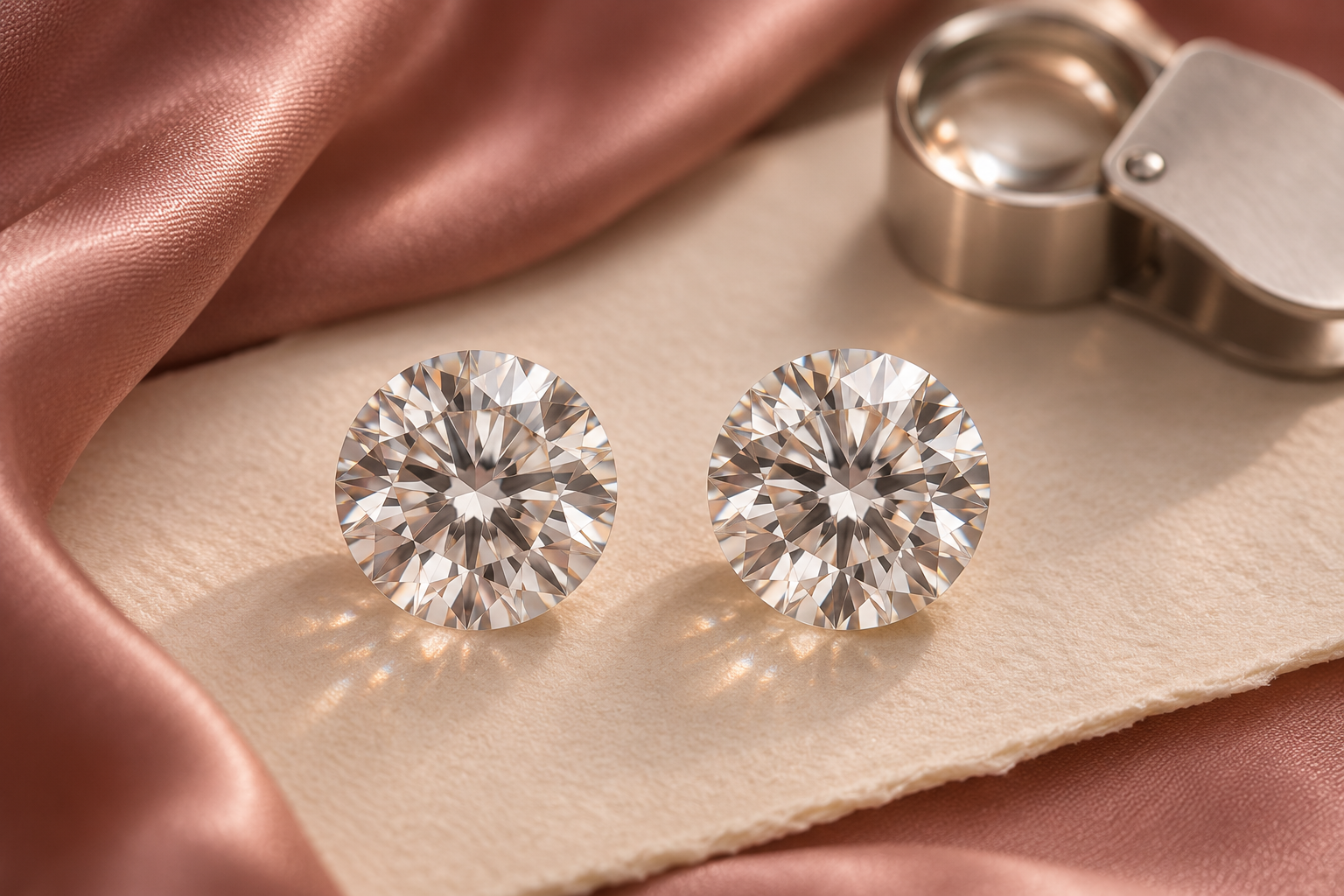
    At the counter, ask to see both stones face up in the same light. If you’re buying online, ask for one photo or video of the two stones side by side. If the seller only has separate videos, ask whether they were shot at the same distance and magnification. A tightly cropped clip can make a smaller stone fill the frame.

    Then compare what you see as the stones tilt. Which one has a pattern of light and dark that you enjoy? Which one do you keep looking back at? A diameter is useful for getting the scale right. GIA’s cut guide explains why diamonds with similar cut grades can still have different proportions and appearances.

    Write these down before you choose

    • Weight and measurements. Copy the carat weight and both diameters from each report.
    • Cut and appearance. Note the cut grade where applicable, then compare the stones in similar light.
    • Total price and return terms. Ask whether the quote includes the setting and what happens if the finished ring looks different from what you expected.

    If two stones are close in width, give yourself permission to choose the one you enjoy looking at. The extra fraction of a carat may matter to you for its own sake. The measurements tell you how much of that difference you can expect to see across the top.

    Further reading

  • Platinum vs. White Gold Wedding Bands: How the Finish Changes

    Platinum vs. White Gold Wedding Bands: How the Finish Changes

    You try on two wedding bands at the jewelry counter. Both are bright white under the display lights, and both look right on your hand. One is platinum and the other is white gold. You could pick the one you like better in the mirror, but what would you choose if you could see how each band might look after a few years of wear?

    That’s the comparison worth making before you pay. Start with what gives each ring its color, then ask to see an example of how its finish changes.

    Find out what gives the ring its color

    White gold is a gold alloy. Many white gold bands have a thin rhodium coating that gives them a bright white finish. As the coating wears, the gold alloy underneath can show through with a warmer tone. The Gemological Institute of America’s ring metals guide notes that white gold can be replated to restore the rhodium finish. Ask to see an unplated sample of the same alloy if the jeweler has one. That gives you a better idea of the underlying color than the display ring alone.

    Platinum is naturally white. An unplated platinum band can pick up fine marks and develop a softer sheen, often called a patina. If you like the high shine of a new ring, ask the jeweler what polishing would involve. Also ask whether the particular platinum ring is plated. Some are, and that changes the upkeep conversation.

    Compare like for like at the counter

    Ask to try on two bands with a similar width, thickness, and shape. A wide band and a thin band can feel quite different, so comparing similar designs makes it easier to decide whether you like the weight and feel of each metal. If you’ll wear it alongside an engagement ring, bring that ring with you and try the pair together.

    Look at both bands under the same light, ideally near a window if the shop allows it. Then ask whether there’s a worn sample or a photo of a comparable ring before it was refinished. A brand-new satin band can help you decide whether you enjoy a softer sheen. A worn sample gives you a more realistic sense of how everyday marks may look.

    Get a written quote for the ring and its upkeep

    Ask the jeweler to identify the metal, purity, and surface finish on the quote or receipt. In the U.S., the Federal Trade Commission’s jewelry buying guide explains that 14K and 18K indicate the gold content, and that a piece described simply as platinum should contain at least 95 percent platinum. Purity tells you about the alloy. Ask about plating separately.

    • What am I buying? Ask for the metal, purity, and whether the band has rhodium plating.
    • How will this finish change? Ask to see a worn example and find out what the shop does to refresh it.
    • What does that service include? Ask about current fees, what the warranty covers, and whether a resized or engraved band can be returned.

    If a crisp, bright-white finish is what you love about a rhodium-plated white gold band, include the jeweler’s replating terms in your decision. If you like the look of worn platinum, ask for an unplated band and see how it feels on your hand. Either way, choose the finish you’d enjoy seeing on a regular Tuesday, long after the first photos are taken.

    Further reading