
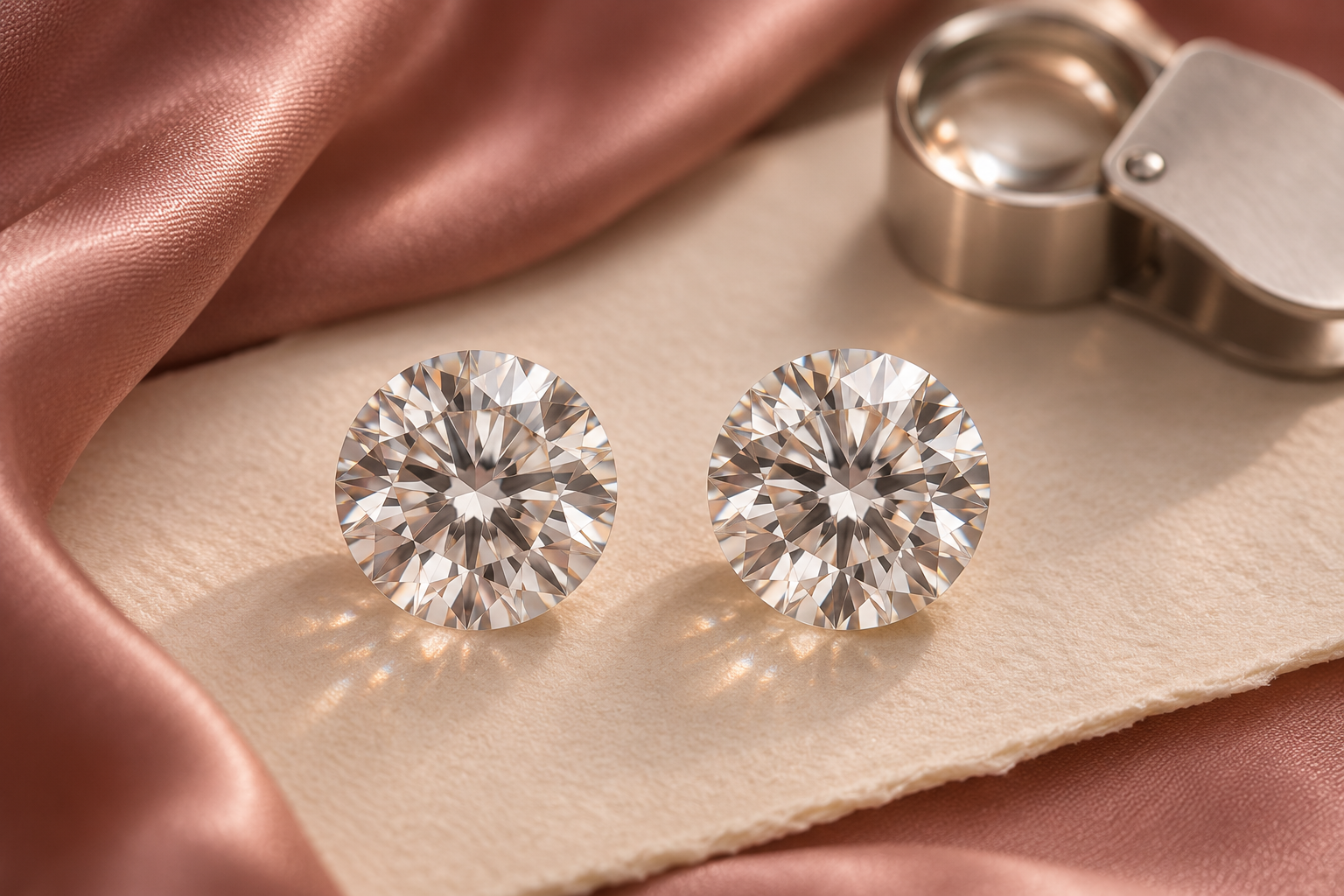
You’ve opened two tabs for round diamonds. One listing says 0.95 carat, the other says 1.02. In the photos, the first stone looks bigger. Both pictures fill the screen, and neither shows a scale. Before you decide which stone gives you the look you want, open the grading reports and find the line marked “Measurements.”
The Gemological Institute of America’s guide to carat weight explains that a carat measures weight. If you want to know how wide a round diamond looks when viewed from above, start with its diameter in millimeters. Different proportions can give two stones a similar face-up width even when one weighs more.
Read the first two numbers on a round diamond’s report
On a GIA report for a round diamond, the first two dimensions are the smallest and largest diameters. The third is the depth, measured from top to bottom. All three are in millimeters. GIA explains how these measurements fit into its guide to diamond cut grades.
Imagine two listings with these made-up measurements. They show how to compare the reports and aren’t benchmarks for what a diamond of either weight should measure.
- Diamond A, 0.95 carat: 6.32 to 6.36 mm across and 3.88 mm deep. Average diameter: 6.34 mm.
- Diamond B, 1.02 carats: 6.33 to 6.37 mm across and 4.01 mm deep. Average diameter: 6.35 mm.
The two diameter ranges overlap. Even though Diamond B weighs more, the reports give you little reason to expect it to look wider. If your main reason for considering Diamond B was the size you’d see on your hand, keep both stones on your shortlist until you’ve compared the way they actually look.
Ask for a comparison at the same scale
At the counter, ask to see both stones face up in the same light. If you’re buying online, ask for one photo or video of the two stones side by side. If the seller only has separate videos, ask whether they were shot at the same distance and magnification. A tightly cropped clip can make a smaller stone fill the frame.
Then compare what you see as the stones tilt. Which one has a pattern of light and dark that you enjoy? Which one do you keep looking back at? A diameter is useful for getting the scale right. GIA’s cut guide explains why diamonds with similar cut grades can still have different proportions and appearances.
Write these down before you choose
- Weight and measurements. Copy the carat weight and both diameters from each report.
- Cut and appearance. Note the cut grade where applicable, then compare the stones in similar light.
- Total price and return terms. Ask whether the quote includes the setting and what happens if the finished ring looks different from what you expected.
If two stones are close in width, give yourself permission to choose the one you enjoy looking at. The extra fraction of a carat may matter to you for its own sake. The measurements tell you how much of that difference you can expect to see across the top.
Further reading
- Gemological Institute of America (GIA), Understanding diamond carat weight. Learn what a carat measures and how diamond weight is reported.
- Gemological Institute of America (GIA), How to read diamond measurements and cut grades. Find out what the dimensions on a report mean and why it helps to compare diamonds in person.


