
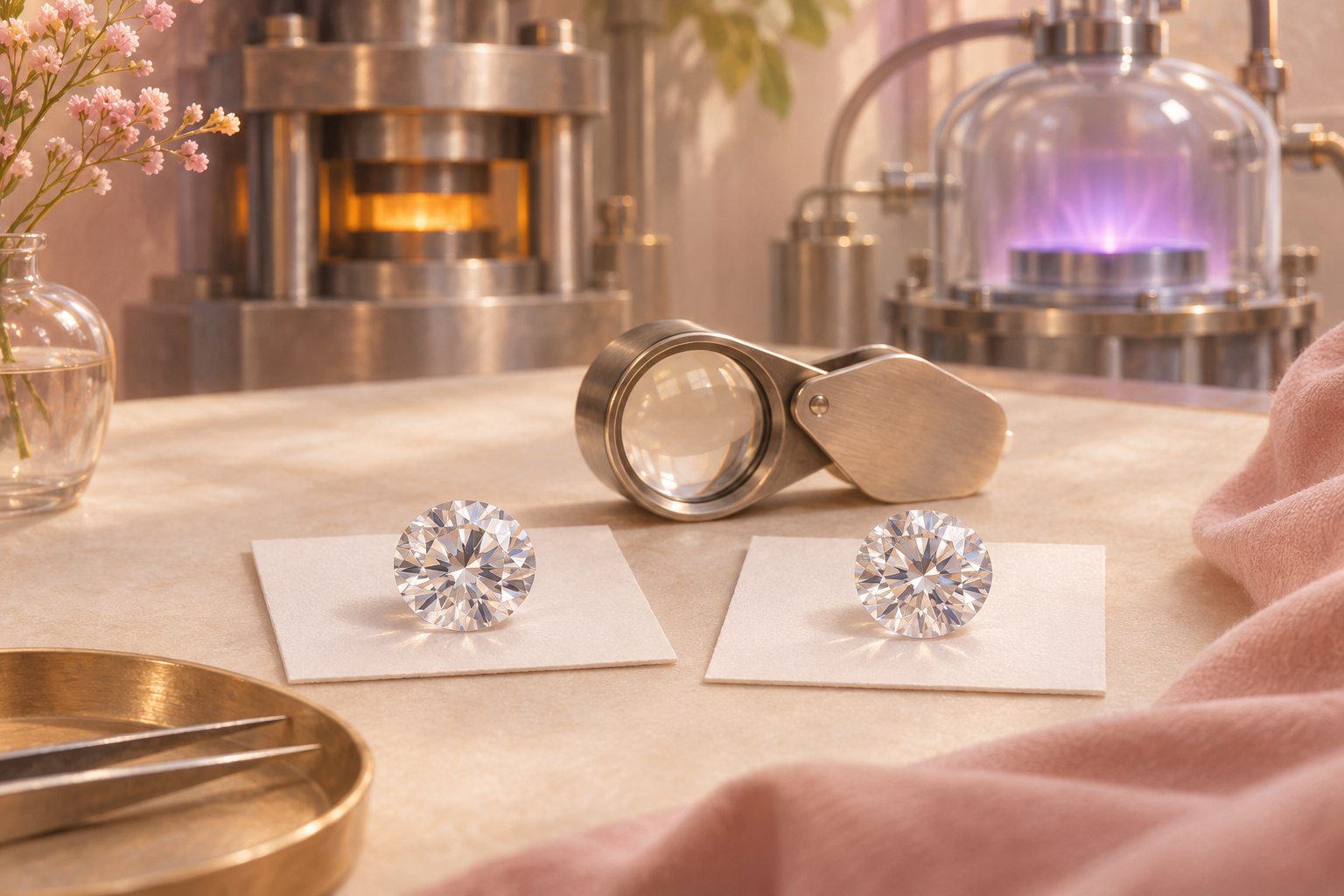
You have two lab-grown diamonds open in separate browser tabs. One listing says CVD; the other says HPHT. The prices and photos look close, and now you are wondering whether one method automatically makes a better diamond.
The short answer: the letters describe how the crystal was grown. They are useful information, but they are not a quality grade. To compare the finished stones, look at the individual diamond, its grading information, any disclosed treatment, and the seller’s written description.
What CVD and HPHT mean
HPHT stands for high pressure, high temperature. In this method, equipment applies intense pressure and heat to carbon around a tiny diamond seed. CVD means chemical vapor deposition: carbon-containing gas in a chamber deposits carbon onto a diamond seed as the crystal grows. The Gemological Institute of America (GIA) explains both processes in its overview of HPHT and CVD diamond growth.
Both methods produce laboratory-grown diamonds. GIA explains that these are diamonds, not look-alike simulants such as cubic zirconia or moissanite. The growth environment can leave characteristics that trained gemologists use for identification, but a shopper should not expect to identify the method by eye from a listing photo.
A growth method is not a quality score
CVD and HPHT do not rank diamonds from best to worst. The method alone does not tell you whether the finished stone has the cut appearance you prefer, the color and clarity you want, or a better price for your budget. Compare the specific stones and their documentation rather than choosing only by the letters CVD or HPHT.
Some CVD-grown diamonds may receive post-growth treatment, including HPHT treatment, to improve or change color. That does not mean every CVD stone has been treated. It does mean treatment disclosure is a sensible question for any candidate, especially when comparing two stones that otherwise seem similar.
What to check in the listing and report
Start with the product description, then compare it with the grading document. GIA says three of its four Laboratory-Grown Diamond Report types include a comment naming CVD or HPHT; this is specific to those GIA report types, so do not assume every laboratory uses the same report format. See GIA’s explanation of which reports show the growth method.
- Identity: Does the report describe a laboratory-grown diamond, and can you verify its report number with the issuing laboratory?
- Growth method: Is CVD or HPHT stated in the report or seller paperwork? If it is missing, ask the seller to clarify rather than guessing from appearance.
- Treatment: Ask whether the stone received any post-growth treatment and where that information appears in the report or sales paperwork.
- Finished stone: Compare cut, color, clarity, measurements, and carat weight for the exact stones. Review actual photos or video when available.
- Written terms: Make sure the invoice or order description identifies the stone as laboratory-grown and records any origin or treatment details the seller has stated.
The Federal Trade Commission’s jewelry buying advice recommends getting important details—such as origin, weight or size, and treatments—in the sales paperwork. It also advises checking a seller’s return policy in writing. A product page may be useful, but save the specific listing and ask for the key details on the order itself.
A simple side-by-side comparison
Make a small table for your two candidates. Put the report number, growth method, disclosed treatments, cut, color, clarity, measurements, price, and return terms in matching rows. If one stone has incomplete information, ask the seller the same questions about both before deciding. This keeps the comparison focused on the diamonds you might actually buy.
Then ask yourself what you notice in the finished stones: which one looks better to your eye in the photos or viewing appointment, and does the documentation match the listing? If a seller cannot clearly explain whether a stone is lab-grown or what its paperwork says, take your time and compare another listing.
CVD and HPHT are helpful clues about a diamond’s path from seed crystal to finished gem. Use them to ask informed questions, then choose from the documented qualities and appearance of the individual stone.
Further reading
- Gemological Institute of America — HPHT and CVD Diamond Growth Processes. An illustrated explanation of how each laboratory growth method works.
- Gemological Institute of America — Which Lab-Grown Diamond Reports Indicate CVD or HPHT?. Shows which GIA report types identify the growth method.
- Federal Trade Commission — Buying Gemstones, Diamonds, and Pearls. Offers consumer guidance on seller descriptions, diamond reports, and what to get in writing.


