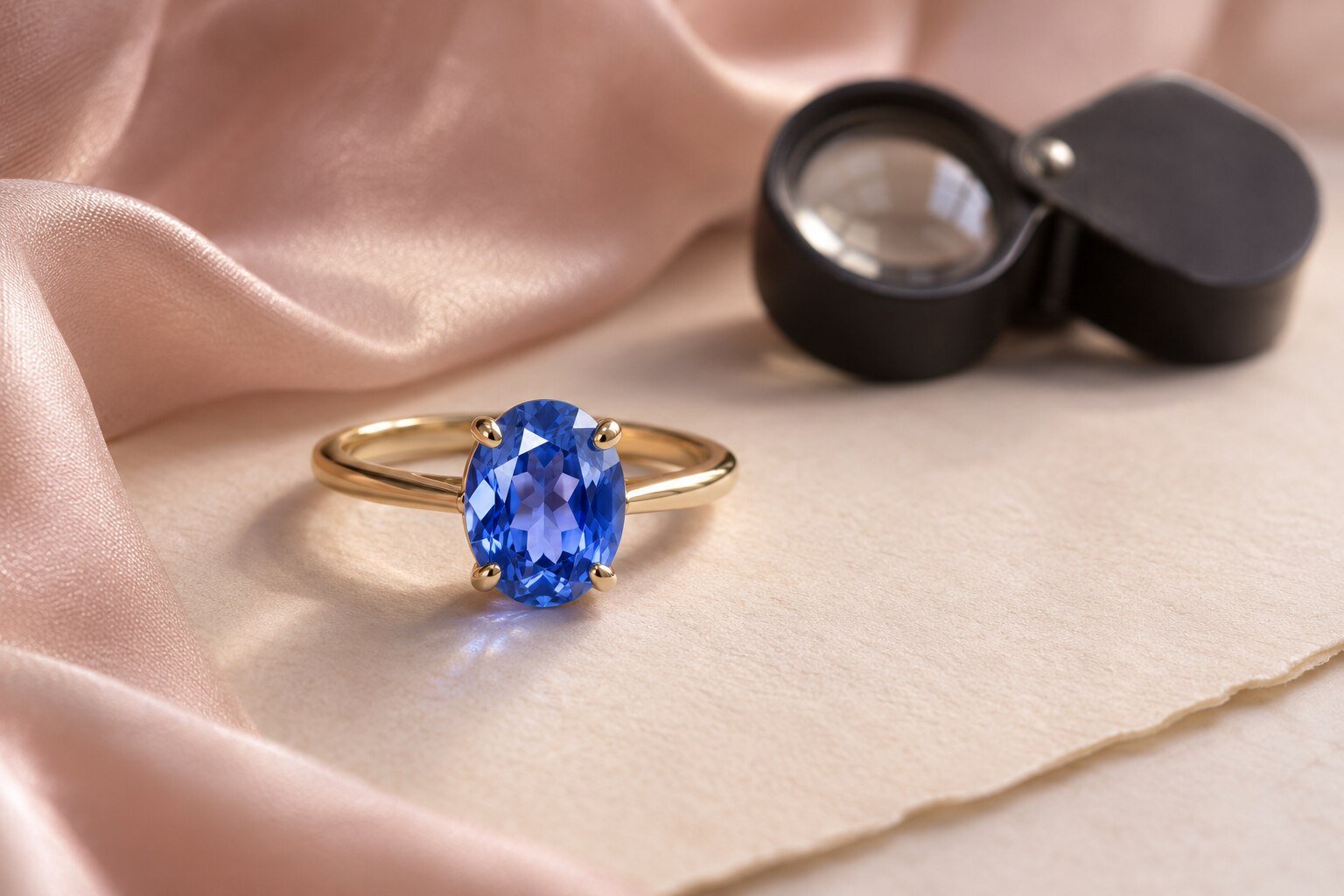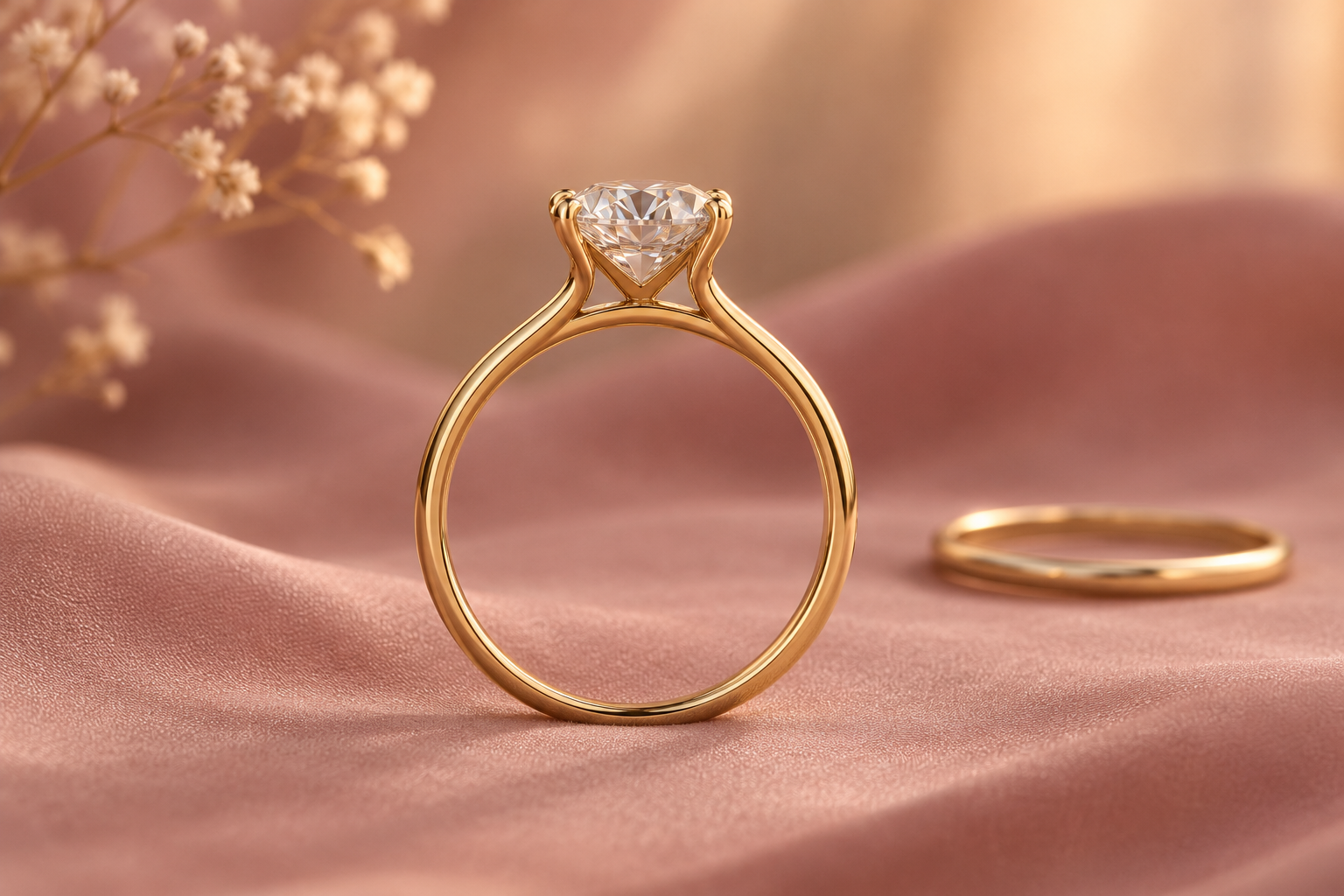
You’ve narrowed it down to two engagement rings. In the photos, both have a round diamond and a slim gold band. You can imagine wearing either one. Then the jeweler turns them sideways. On one, the diamond sits close to the band. On the other, it rises above it, with room underneath. That small turn tells you something the prettiest photo in the listing may have missed.
Before you decide, ask for a photo of the ring straight from the side. It can help you picture how the setting will feel in everyday wear and how it might sit next to a wedding band. Here’s what to look for.
Look at the height and how the stone is held
Find the metal that holds the center stone, then trace where it meets the band. A setting that rises well above the finger gives the ring a more pronounced silhouette. If you like the idea of a ring that sits close to your hand, ask to compare a lower-profile option with a stone of similar size. For online shopping, ask for the overall height in millimeters and have the seller explain where they measured from. A tight crop can make two very different profiles look alike.
Look at the edges, too. The Gemological Institute of America’s guide to ring settings explains that raised prongs can catch on fabric and that a bezel surrounds the edge of the stone with metal. If sweaters or gloves are part of your everyday routine, compare a smooth bezel with a low-set prong ring. A side photo helps you see what protrudes. If you can try the ring on, notice how it feels as you move your hand and pull down a sleeve.
Ask to see the wedding band beside it
A straight wedding band may meet the base of the engagement ring’s setting before the two bands touch along the finger. The side photo is a clue. A photo of the two rings together gives you a much better answer. Ask the jeweler to show your preferred band width and shape next to the engagement ring, from above and from the side. If you already own the band, bring it along.
Look at the gap, if there is one, and decide whether you like how it looks. Some people enjoy seeing a little space between two rings. If you want them to sit close together, ask whether a straight band fits or whether you’d prefer a curved or contoured band. Get a price for the pairing you’d actually wear before you compare it with another ring.
Send this three-question message before buying online
- Could you send a straight side photo or short video of this exact ring, or of the same setting with a center stone of the same dimensions?
- How high does the finished setting sit, and where do you measure from?
- Could you show it next to a straight wedding band in my preferred width and tell me whether the setting leaves a gap?
If the ring will be made to order, ask whether the images show a finished sample or a rendering. Get the expected dimensions and the seller’s return or alteration terms in writing, especially if the ring will be resized or customized.
Picture an ordinary day
Once you have the photos, imagine wearing each ring on a regular Tuesday. Think about what your hands do, what you wear, and whether you’ll want to add a second band. You may still fall for the taller setting. The side view gives you a chance to fall for the whole ring, including how it fits into your life.
Further reading
- Gemological Institute of America (GIA), Guide to engagement ring settings. See how prongs, bezels, and baskets hold the stone, with photos of different designs.
- Gemological Institute of America (GIA), Questions to consider before buying a diamond engagement ring. Use this guide to prepare for a conversation about the wearer’s style, daily routine, and preferred metal.