
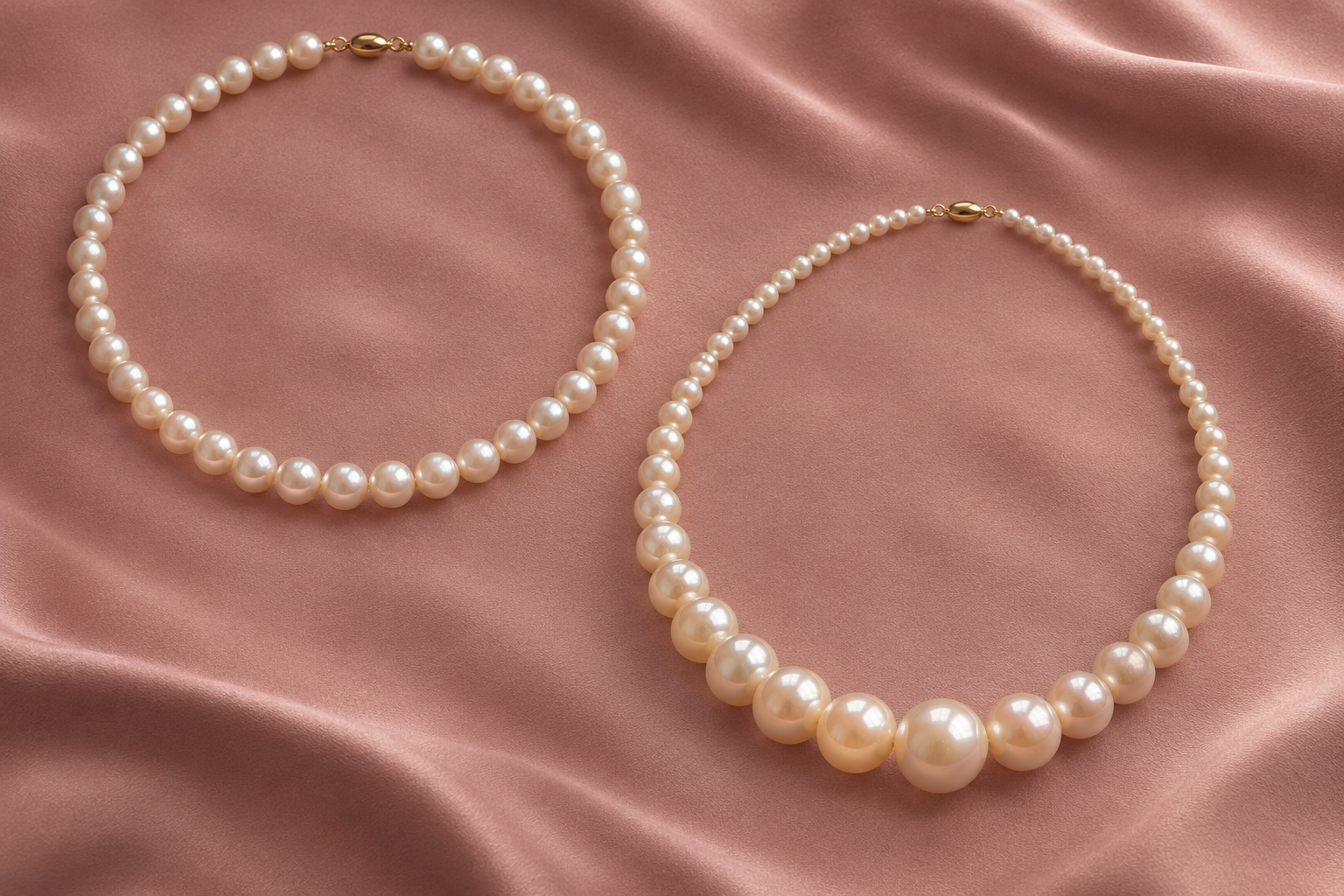
You’re choosing between two pearl necklaces. In one listing, each pearl is so bright it looks as though a window is reflected in it. In the other, the pearls have a soft glow. The photos were taken on different backgrounds, and one is zoomed in so far that you can’t see the clasp. Before deciding which strand you like better, ask to see both under the same light.
That comparison gives you a way to judge two different things. Look at the reflections on individual pearls for luster. Then look at how the pearls work together along the necklace for matching. A single close-up can tell you a little about the first. You’ll want to see the whole piece for the second.
Compare reflections under the same light
The Gemological Institute of America’s guide to pearl quality describes stronger luster in terms of brighter, sharper reflections. At a counter, ask to set the two strands on the same plain surface in one spot. Look for the edge of a reflected light or window as you change your viewing angle. Does it look distinct, do the edges soften, or does the bright area spread out into a haze? Compare several pearls on each necklace.
Online, ask for a short unfiltered video of the exact strands side by side. Give the seller one simple setup to use for both, such as a plain background near a window in indirect daylight. Ask them to tilt the strands slowly and keep the camera distance the same. If you’re comparing listings from different stores, ask each for similar views and treat any comparison as approximate. GIA also notes that luster standards differ by pearl variety, so comparing strands of the same type gives you a more relevant starting point.
Follow the pattern from the center to the clasp
If you want an evenly sized strand, follow one side from the center toward the clasp. Look at the size, shape, color, and reflections from one pearl to the next. Do the changes feel subtle, or does one pearl jump out when you look at the whole necklace? The GIA pearl buyer’s guide lists matching among the factors used to evaluate jewelry containing multiple pearls.
If you like a graduated strand, where the pearls step down in size toward the ends, compare the left and right sides at roughly the same distance from the center. Ask for the smallest and largest pearl measurements and look at how the change reads when the necklace is curved as it would be when worn. For a multicolored or irregularly shaped strand, look for a mix you actually enjoy. GIA points out that designers sometimes choose differences on purpose. You can still ask whether an abrupt change you see is part of that design.
Separate marks on the surface from the overall reflections. Take a closer look if one pearl has a spot that catches your eye, then step back to the distance at which you’d usually see the necklace. For an online purchase, ask for photos of the section you’d like to inspect more closely, including the pearls near the clasp if the full-strand shot leaves them in shadow.
Ask for details about the exact necklace
- Can you show me the whole strand and close-ups of the center and both ends under the same light?
- What pearl type is this, what is the size range in millimeters, and is the variation in size or color intentional?
- If there’s a lab report, can I see the full report and confirm that it covers this strand?
Read what the report actually covers. GIA’s pearl report comparison shows that its identification report records details such as size and detectable treatments, while its identification and classification report also addresses luster, surface, and matching where applicable. A good photo helps you compare the look of two necklaces. A report answers different questions about the pearls that were examined.
Before you pay, describe the strand you prefer in one sentence. You might like the way the bright reflections carry through the whole piece, or the way the pearls taper gently away from the center. That’s a better basis for choosing than trying to remember which listing looked brightest on your phone.
Further reading
- Gemological Institute of America — Pearl Quality Factors. See illustrated examples of luster grades, surface characteristics, and matching.
- Gemological Institute of America — Pearl Buyer’s Guide. Browse examples of the size, shape, color, and other details you can compare before buying.
- Gemological Institute of America — Pearl Reports & Services. Compare report types and see which ones cover luster and matching.


